HV Motor Repair & Services
Complete Guide to HV Motor Repair, Stator Rewinding & Overhaul Services
High Voltage (HV) induction and synchronous motors are critical assets in industrial facilities. Operating under high dielectric stress, continuous thermal cycling, and heavy mechanical loads, an unexpected HV motor failure can lead to catastrophic plant downtime. Implementing precision maintenance, high-voltage insulation testing, and expert stator rewinding is essential to maintaining system reliability and extending equipment life.
Advanced High-Voltage Electrical Diagnostics & Insulation Testing
Diagnosing an HV motor requires advanced non-destructive testing (NDT) to evaluate the condition of Class F and Class H insulation systems before taking the machine offsite.
Critical Diagnostic Testing Protocols:
- Partial Discharge (PD) Analysis: Detects internal void formation, corona discharge, and microscopic insulation degradation within stator coils.
- Dissipation Factor ($\tan \delta$) & Tip-Up Testing: Measures dielectric losses in the ground-wall insulation to evaluate moisture or thermal aging.
- Polarization Index (PI) & Megger Test: Verifies insulation resistance over a 10-minute ratio test ($PI = R_{10min} / R_{1min}$), requiring a minimum target threshold of $PI \ge 2.0$.
- Surge & Hi-Pot Testing: Assesses phase-to-phase and turn-to-turn dielectric strength under controlled high-voltage conditions.
Form-Wound Stator Rewinding & Vacuum Pressure Impregnation (VPI)
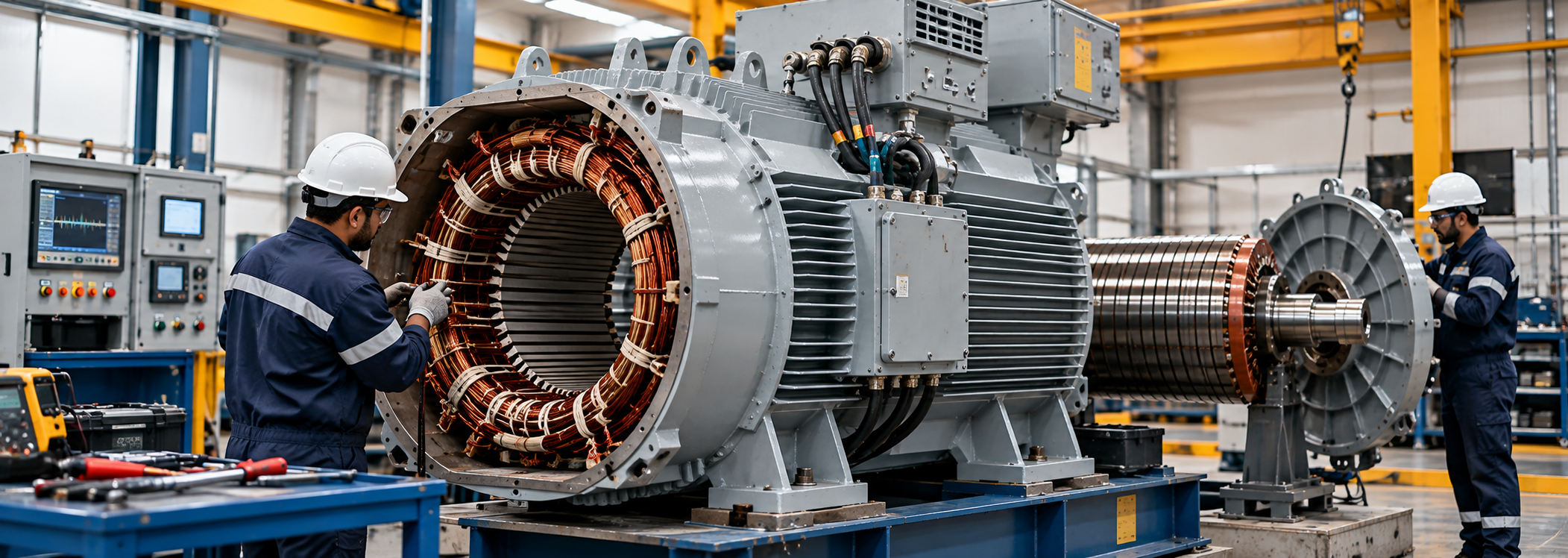
Unlike low voltage random-wound motors, HV motors utilize form-wound stiff coils wrapped in mica glass tape. Restoring an HV stator requires absolute precision in coil fabrication and resin impregnation.
High Voltage Rewinding Steps:
- Stripping old damaged coils using controlled thermal burnout ovens to prevent core lamination shorting.
- Manufacturing precision form-wound coils using high-grade copper conductors.
- Applying multi-layer mica tape insulation with conductive end-turn grading tape to control electrical stress fields.
- Executing Vacuum Pressure Impregnation (VPI) with solventless epoxy resin to eliminate micro-voids and secure maximum dielectric integrity.
Dynamic Balancing & Mechanical Journal Machining
Mechanical wear on heavy HV motor shafts can cause high-frequency vibration, bearing housing enlargement, and internal air-gap distortion between the rotor and stator core.
Mechanical Restoration Standards:
- Dynamic Rotor Balancing: High-speed balancing executed on computerized dynamic balancing machines up to ISO 1940 Grade G1.0/G2.5 tolerances.
- Journal & Housing Restoration: Precision lathe machining, micro-sleeving, or thermal spray metallizing for worn bearing journals and end-cover shield housings.
- Sleeve & Anti-Friction Bearing Overhaul: Replacement or white-metal rebabbitting of sleeve bearings and precision fitting of C3 clearance rolling-element bearings.
On-Site Precision Laser Shaft Alignment
Coupling an overhauled HV motor back to a heavy pump, compressor, or gearbox requires zero-tolerance mechanical alignment to avoid radial forces that cause premature bearing failure.
Using dual-laser alignment systems, engineers eliminate parallel and angular misalignment, correct soft-foot conditions, and record final thermal growth offset parameters prior to plant commissioning.
| Parameter | Minor Workshop Overhaul | Complete HV Stator Rewind | New HV Motor Procurement |
| Turnaround Time | 3 to 5 Days | 10 to 20 Days | 16 to 36 Weeks (Lead Time) |
| Capex Requirement | 10% – 20% of New Unit | 35% – 50% of New Unit | 100% Capital Outlay |
| Insulation Grade | Inspected / Dipped | New Class H VPI System | Factory OEM Class H |
| Warranty Coverage | Service Warranty | Full Overhaul Warranty | OEM Standard Warranty |