LV Motor Repair & Services
The Ultimate Guide to LV Motor Repair and Maintenance Services
Low voltage (LV) electric motors (typically operating below 1,000V) drive critical industrial infrastructure. Whether operating a 15 kW variable frequency drive (VFD) pump motor or a 75 kW FAHU blower unit, routine inspection, precision bearing replacement, stator rewinding, and laser shaft alignment are essential to prevent catastrophic operational failure.
Initial Mechanical & Electrical Diagnostics
Before performing any mechanical teardown, qualified technicians execute a comprehensive electrical insulation resistance test using a megohmmeter (Megger test) alongside winding resistance checks.
Key Diagnostic Steps:
- Insulation Resistance Testing: Verifies phase-to-phase and phase-to-ground insulation integrity (minimum acceptable threshold: $R_{insulation} \ge 100 \text{ M}\Omega$).
- Vibration Analysis: Detects early-stage bearing race degradation, mechanical looseness, and dynamic imbalance.
- Thermal Imaging: Identifies localized hot spots caused by shorted stator laminations or poor terminal connection points.
Precision Stator Rewinding & Insulation Restoration
When moisture ingress, over-current conditions, or thermal breakdown degrade the copper windings, complete stator rewinding becomes necessary.
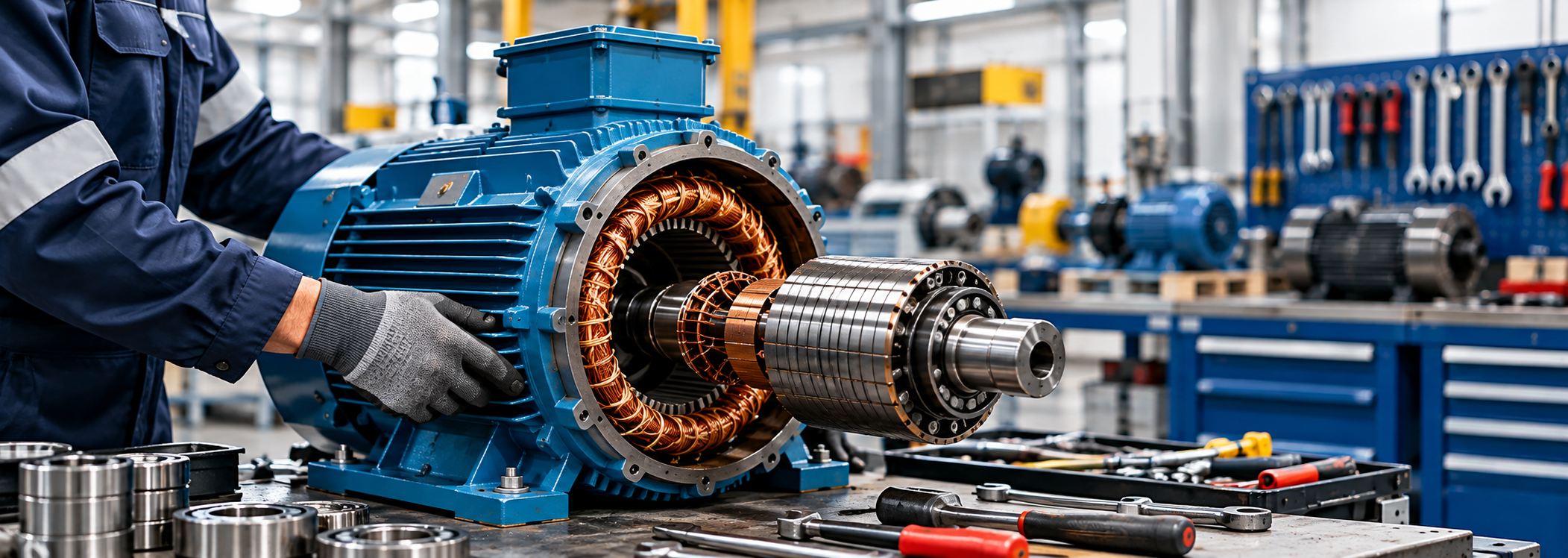
Technicians strip damaged coils, clean the core laminations, install Class H insulation slot liners, and precisely rewind high-grade enamel copper wire. Following rewinding, the assembly undergoes Vacuum Pressure Impregnation (VPI) or dip-and-bake resin coating to eliminate air voids and enhance dielectric strength.
Mechanical Overhaul, Machining & Bearing Replacement
Bearing failure accounts for over 50% of all electric motor breakdowns. Worn deep-groove ball bearings or cylindrical roller bearings generate severe axial vibration and cause internal rotor-to-stator contact (rubbing).
Overhaul Execution Checklist:
- Safe extraction of worn bearings using hydraulic pullers to avoid shaft score marks.
- Lathe machining and sleeve restoration on end-cover bearing housings or damaged shaft journals.
- Precision fitting of new C3 clearance bearings using induction heaters to ensure precise thermal expansion fitting.
Dynamic Balancing & Laser Shaft Alignment
After mechanical reassembly, the motor rotor is dynamically balanced on a balancing machine to ISO 1940 standards to eliminate rotational vibration.
During final site installation, technicians execute laser shaft alignment between the motor output shaft and driven equipment (pumps, gearboxes, or fans). Precise laser alignment eliminates soft-foot conditions, reduces thermal stress, and extends bearing operational life up to 300%.
| Repair Parameter | Standard Overhaul | Full Stator Rewind | Complete Motor Replacement |
| Typical Turnaround | 24 – 48 Hours | 3 – 5 Days | 2 – 4 Weeks (Lead Time) |
| Cost relative to New | 15% – 25% | 40% – 60% | 100% + Installation |
| Dielectric Testing | Surge & Megger Test | High-Pot & Surge Test | Factory Test Certificate |
| Expected Asset Life | +3 to 5 Years | +7 to 10 Years | Full OEM Lifecycle |