Motor Offline Diagnostic Testing
The Ultimate Guide to Motor Offline Diagnostic Testing & Electrical Health Analysis
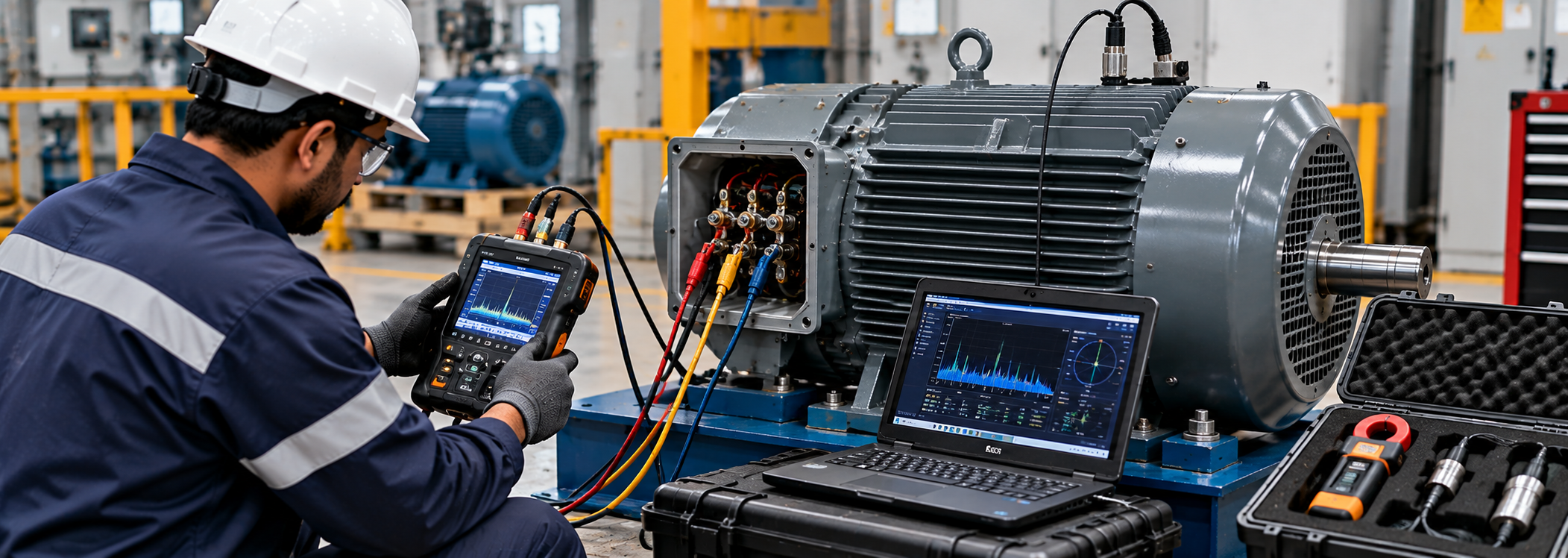
Electric motor reliability underpins industrial manufacturing, commercial HVAC networks, and power generation plants. While online vibration and current analysis monitor running conditions, offline motor diagnostic testing provides an in-depth evaluation of the stator insulation, rotor integrity, and ground-wall health while the motor is de-energized.
Executing routine offline testing prevents unexpected trips, reduces emergency rewinding costs, and maximizes asset lifespan.
Insulation Resistance (IR) & Polarization Index (PI) Testing
Insulation resistance testing evaluates the integrity of ground-wall insulation separating phase windings from the motor frame.
Key Testing Metrics:
- Insulation Resistance (IR): Applies DC voltage (500V to 5,000V) to check for moisture ingress, contamination, or dielectric breakdown.
- Polarization Index (PI): Calculated as the ratio of 10-minute resistance to 1-minute resistance ($PI = R_{10\text{min}} / R_{1\text{min}}$). A target $PI \ge 2.0$ confirms clean, dry insulation.
- Dielectric Absorption Ratio (DAR): Compares 60-second to 30-second insulation resistance to detect early insulation aging.
Winding Resistance & Phase Balance Measurement
Milliohm winding resistance measurements detect loose internal connections, open turns, and phase imbalances caused by overheating.
Winding Balance Parameters:
- Phase-to-Phase Resistance Balance: Identifies copper line resistance deviations. A phase imbalance exceeding 2% indicates bad connection crimps, corroded terminal studs, or partial turn shorts.
- Temperature Compensation: All resistance values are normalized to 25°C or 75°C standard reference temperatures to ensure historical trend accuracy.
High-Voltage Surge Testing & Partial Discharge (PD) Analysis
Standard megger tests cannot detect turn-to-turn insulation weakness because turn-to-turn voltages remain low. Surge testing uses fast-rise voltage pulses to identify weak turn insulation before it develops into a phase-to-ground fault.
Advanced Diagnostic Features:
- Surge Comparison Waveform Analysis: Compares voltage pulse decay curves across phases. Mismatched pulse frequencies indicate turn-to-turn or coil-to-coil insulation shorts.
- Offline Partial Discharge Testing: Detects microscopic internal void discharges in High Voltage (HV) form-wound stator insulation prior to complete ground fault failure.
Rotor Influence Check (RIC) & Inductance Testing
Testing stator inductance across various rotor positions isolates squirrel-cage rotor defects, broken rotor bars, and air-gap eccentricities without dismantling the motor.
By recording phase inductance variation ($L$) as the rotor turns manually, engineers map out rotor bar symmetry and spot dynamic air-gap distortions between the rotor and stator core laminations.
| Diagnostic Test Method | Target Defect / Failure Mode | Test Voltage Range | Primary Standard / Guideline |
| Insulation Resistance (IR / Megger) | Moisture, Dirt, Ground-Wall Degradation | 500V – 5,000V DC | IEEE 43-2013 |
| Polarization Index (PI) | Insulation Contamination & Thermal Aging | 500V – 5,000V DC | IEEE 43-2013 |
| Winding Resistance Test | Loose Connections, Open Turns, Corrosion | Low DC Current (<10A) | IEEE 118 / EASA Standards |
| Surge Voltage Testing | Turn-to-Turn & Coil-to-Coil Insulation Shorts | Up to $2V_{rated} + 1,000V$ | IEEE 522 / IEC 60034-15 |
| Rotor Influence Check (RIC) | Broken Rotor Bars, Eccentric Air Gaps | AC Low Voltage / Inductance | IEEE 1415 |